
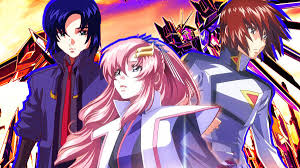
(An analysis of anti-war messaging, propaganda, child soldiers, and extremist ideology in Gundam anime)
I live on social media, essentially. And something that pops up on my feeds is the ‘what radicalized you’ meme.
I have people in my life who wonder why I am the way I am.
My media – things I have consumed when I was a child (mostly anime, to be honest) had many anti-war messages and acceptance of others.
Gundam Wing

Gundam Wing is one of the first Gundam series I watched. This series follows the mobile suit pilots (all minors), with Heero being 15 (Relena Peacecraft being 14) and the others being 15-16 by the end of the movie Endless Waltz.
In regard to immigration, as with many of the Gundam Series (I will touch on this in the Gundam SEED section), Space colonies are essentially diaspora populations exploited by Earth elites. Colonists are treated as second-class citizens and denied political voice. Many fighters are effectively refugees and political exiles.
This is a mirror of the colonial extraction and migrant labor populations. Immigrants are shown to be the ‘others’ and the use of that propaganda. It reflects how the ruling classes economically benefit from colonial oppression. And we can look to media propaganda that paints colonists as terrorists in this series and how it reflects real life (have you heard American Idiot?).
Further, we can look to Gundam Wing as overall the most explicitly anti-war anime ever broadcast. Why?
It shows war as manufactured consent. Manufactured consent is the theory, as written and detailed in Manufacturing Consent by Noam Chomsky and Edward Herman, that mass media and powerful institutions shape public opinion to align with the interests of the ‘elites.’ This creates an illusion of consensus (or “consent”) for policies without the overt coercion. This is done through the use of propaganda, framing, and the filtering of information. In other words, by controlling the flow of information, marginalizing dissenting views, and dominating groups, securing public acceptance for their agendas, the people become a support system for what may not be in their best interests.
Gundam Wing shows this through the Earth leaders manipulating the public fear to justify the crackdown on the colonies. “Peacekeeping” forces are occupation armies (similar to “peacekeepers” in the Hunger Games) and the propaganda from the Earth leaders reframes resistance as terrorism (similar to the US currently exusing the use of force ICE is currently using in Minnesota protesters).
Additionally, as mentioned, the main characters are all minors. The Gundam pilots are isolated and treated as symbols — not humans. They are praised when useful and are discarded when they are politically inconvenient. The State romanticizes youth sacrifice while destroying the lives of these pilots, who are children.
There is also the fact that each attempt to impose peace through force has a stronger backlash. Which is similar to the US entering whatever Middle Eastern country because of the Islamic State, and the death of those with families dying in turn caused radicalization of the survivors.
Eventually, the characters slowly realized that violence cannot produce stable peace, only temporary dominance. This means that ideologically, “noble” wars become machinery that feeds on political propaganda and human bodies, making martyrs out of children.
G Gundam

This was released a year prior to Wing. Released in 1994, it shows militarism disguised as sports.
So, looking at this, as most of the cast are adults, the main characters Rain and Domon are both 20 years old. Every four years, like a fucked up Olympic Games, nations send champions to fight in a martial arts tournament called the Gundam Fight. These champions are from the space colonies on Earth to determine which nation will rule the colonies for the next four years. The logic is that it prevents large-scale wars between the space colonies through structured, sportsmanlike combat.
The cities are destroyed as collateral. It is an international war that is turned into a televised tournament. Instead of armies killing civilians, elites can say, “hey guys! We’ve civilized war! It’s just like the former Olympic games of past generations!” Even though Earth still suffers from devastation, and colonies still impose rule through force. Making war into a sport doesn’t make it moral — it just hides the victims and bodies.
Unlike in Wing, the fighters in G Gundam are adults, and politicians are fully aware of the consequences. This means that engineers are knowingly designing weapons of mass destruction.
This means that the excuses of youthful ignorance, like the Wing pilots and manipulation of the Earth forces, are removed. People fight because of nationalism, ambition, revenge, and loyalty to the corrupt system. Meaning: War persists not because people understand the cost, but because institutions reward participation.
I will say, my favorite thing about G Gundam is that there are national stereotypes. America = guns and boxing; Russia = harsh stoicism; China = tradition and honor; Neo Germany = romantic militarism. But there is a critique here.
It is critiquing human beings to national caricatures, treating countries as personalities that must “win.”
The implication is that national pride becomes a personal identity and an emotional justification for violence. Nationalism simplifies complex societies into flags people are willing to kill for.
There is also the Devil Gundam, which is militarism as a self-perpetuating system. It self-repairs, self-evolves, and infects ecosystems and humans. Symbolically, you can see it as a representation of the military industrial complexes and war technologies that escape political control, where even the creators can no longer stop it. It shows that once weapons systems are built to grow, adapt, and justify themselves, war becomes autonomous. Militarism becomes a living system that feeds on societies.
Gundam SEED

Gundam SEED is probably the anime that did the most to teach me about racial hatred and biological demonization. This entire series is about how societies turn fear into a total war aimed at erasing entire populations. And it is probably the Gundam series that has stuck with me the most.
So, in SEED there are two main factions of humans. Naturals, meaning humans with no modifications done to them, and Coordinators, meaning humans who are genetically enhanced.
Each side claims the other is unnatural, dangerous, and morally corrupt in one way or another. SEED shows the direct critique of eugenic ideology, ethnic cleansing rhetoric, and the existential threat framing. Negotiation becomes impossible once “they must be eliminated for us to survive” is the driving factor in politics. War becomes genocide when identity replaces politics.
SEED shows, unlike some Gundam series, that leaders are not simply corrupt… but that they are ideologically extreme.
Patrick Zala
I never liked Patric Zala, Athrun Zala’s father. Like, if Patrick Zala has no haters, I am dead. Patrick Zala is a genocidal nationalist.
Even before the war, he was a hard political operator. He was obsessed with securing Coordinator independence and power by any means necessary. He used his charisma and inspiration while he was a bitter authoritarian willing to impose his will.
The main trigger that drives him absolutely batshit insane is the Bloody Valentine Incident, where his wife Lenore was killed. It radicalized him considerably, which is not so different than the real world scnario where it happens. Because of the Bloody Valentine Incident, he believes that Coordinators are a separate and superior species and all Naturals need to be wiped out for the continued survival of Coordinators. His grief became his ideology.
As the war continues, he escalates to the manipulation of information to boost public support for supremacist policies, orders arrests and assassinations of political opponents, develops illegal nuclear and mass destruction weapons, and becomes openly genocidal and paranoid. Eventually, he turns around and uses the GENESIS weapon even if it irradiates Earth, kills his force,s and he is willing to kill his own aide and his own son. The son who lost a mother during the Bloody Valentine Incident. He’s not just batshit — he’s an apocalyptic purifier.
Let’s talk about how the logical endpoint of this genocidal maniac is “creation of the Coordinators’ world.”
Right before firing Genesis, he explicitly frames the genocide as world-building: “Let this light usher in the creation of the Coordinators’ world!” So this isn’t just run-of-the-mill wartime retaliation and revenge for the death of his beloved wife… It’s full-blown ethnic genocidal supremacy.
Blue Cosmos
Blue Cosmos, the anti-Coordinator group, is just as batshit as Patrick. Both of them are not just “at war,” they want total extermination.
Blue Cosmos ideology states that genetic modification violates the natural order of things. That all Coordinators must be exterminated under the guise of protecting a “blue and pure world.”
Blue Cosmos destroyed Junius Seven (this is the Bloody Valentine Incident), has attempted nuclear attacks on PLANT colonies, and ran phantom rain and biological experiments (creating indoctrinated child soldiers). Which means, like Patrick Zala, Blue Cosmos is dedicated to the embracing of total war and mass civilian death to justify their end.
How are they different?
While Patrick Zala believes in racial hierarchy, Blue Cosmos was originally an environmental group. They framed their genocidal maniac as a moral hygiene.
They are the opposite in supracy narratives:
Patrick Zala: We are the next stage of humanity
Blue Cosmos: You are corrupting humanity
Further, Blue Cosmos is a covert ideological network, embedded in governments and coporations and they operate via terrorism, coups, and proxy forces… as opposed to Patrick, who is the Head of ZAFT and acts with the formal governmental authority as the Chairman of PLANT’s Supreme Council. So while Blue Cosmos is not the state, they infect the state, whereas Patrick Zala turns genocide into official national policy.
Their psychological origins are also different. Blue Cosmos’ motivation is the long-term ideological hatred of the fear of genetic replacement, and is the political radicalization over the decades. It’s institutional hatred, not personal grief.
Patrick Zala, as mentioned above, becomes more radicalized by the death of Lenore, which makes his personal pain the planetary policy that leads to political absolutism, where the only option is genocidal mania.
Tragic Irony of the Two Sides of Genocidal Extremeism
They feed each other’s narratives. SEED frames war as self-sustaining. Afterall, Blue Cosmos destroyed Junius Seven, which is the Bloody Valentine Incident. Lenore, Patrick’s wife, died in the incident. Patrick will fire Genesis at Earth, justifying the propaganda of Blue Cosmos.
This shows that each atrocity becomes the moral proof for the next one.
The Trauma and Radicalization of Survivor’s Guilt
Somewhere in between the two factions lies Flay Allster. As a child, I hated her – I still kind of do, but I can understand that she was a child when the person she loved the most died. And she struggled with survivor’s guilt.
Her emotional collapse began during a Coordinator’s attack, and she survives by chance; this cripples her social world instantly. This is classic survivor’s guilt: “Why did I live when he didn’t?” “Someone must be responsible.” “If I find a target, the pain will make sense.”
But instead of processing the grief, which is hard to do in the wartime they live in currently, she is immediately thrown into the military chaos and surrounded by armed strangers. She has also been fed the radicalized propaganda, so, as traumatized brains often will, she simplified it: All Coordinators are responsible.
Like Patrick Zala, her personal tragedy turned into a generalized enemy identity and gave her the moral permission for violence. So, as SEED shows, she supports Blue Cosmos ideology, utilizes slurs, and frames the extermination of Coordinators as justice for her father’s death. She is what the survivors of war become… radicalized civilians.
She trauma bonds with Kira, which is what her relationship is based around, not love. She doesn’t choose him because she loves him. He is close enough to emotionally control. That he is a weapon she can point at the enemy (although her enemy is Coordinators, and he is one). She even tells him, “As long as you fight, I can keep going.” Flay and Kira are not a romance; it is using someone’s survival as emotional anesthesia.
As such, she is pushing Kira to fight harder and reinforces that he must keep fighting and discourages him from questioning war. After all, if Kira dies, her guilt is then transferred onto him, her anger is validated, and her worldview of “this war is inevitable” is proven right.
Flay is an emotionally scarred teenager who has been given the ideological permission to hate, and she has been emotionally rewarded for supporting violence. SEED makes the point with Flay that wars are not only sustained by the generals, but they are also sustained by the traumatized civilians who want their pain to mean something. Flay is the microcosm of how entire populations radicalize.
When Flay eventually dies, it is not as a villain at all. She was not redeemed by heroics. She was a frightened civilian. Her last moments are confused, regretful, and finally sees Kira as a person… not the weapon she used him as.
SEED refused to give her the triumphant redemption arc, but it didn’t give her the villain punishment. Her arc is meant to feel unresolved and unfair because that is how civilian trauma usually ends in wars.
Instead, it said: War kills people before they can emotionally recover from what was already done to them.
Soldiers as Disposable Instruments of Ideology
Most of the characters are minors at the beginning of the series. Kira Yamato is 15/16, Athrun Zala is 16, Cagalli Yula Athha is 15/16, and Lacus Clyne is 16. The other Gundam pilots for ZAFT are 16 (Dearka Elthman), 17 (Yzak Joule), and 15 (Nicol Amarfi).
SEED repeatedly emphasizes that the recruits are emotionally unprepared for full-scale war, and they are fed simplified propaganda. Civilian casualties are constant as neutral colonies are destroyed, refugees are repeatedly displaces and medical ships are attacked. As such, characters suffer survivor’s guilt, emotional numbness, and moral collapse. Meanwhile, the system does not care. Afterall, militarized societies treat human beings as ideological ammunition.
Friendship across Enemy Lines: A Rejection of War Logic
Kira Yamato and Athrun Zala are not rivals. They are best friends. Their personal relationship with each other contradicts the nationalist narrative (especially that of Athrun’s father, Patrick). It is proof that: Enemies? They are socially manufactured by the institutions, forcing them into opposing uniforms.
Structurally, their friendship is a direct threat to the propaganda the two forces are trying to push… because it proves the enemy is not inherently monstrous. Which is exactly why the two sides try to isolate and reprogram their soldiers emotionally. War depends on severing social bonds across borders.
Nonviolence is Never Enough
Orb tries to be neutral and pick neither side. They don’t want to be aligned; They want peace. But they end up invaded, destroyed, and forced into militarization.
Kira tries to protect people without killing and choosing sides, after all, he was born in Mendel Colony and grew up on the neutral space colony Heliopolis. His best friend is the son of the genocidal maniac leader of ZAFT. It is the system of war that does not allow moral neutrality and forces one into participation.
This shows that SEED admits that pacifism alone cannot stop militarized empires, but violent victory also cannot end ideological hatred. War traps even those who want no part of it.
Endgame
SEED’s climax is not the defeat of the bad guy, and peace is restored. Instead, it is more realistic. Both extremist leadership factions must be dismantled, superweapons must be destroyed, and the very political structures that got them there must be changed. Even then, peace is fragile (this leads directly into SEED Destiny).
How did these stories affect my ideology?
As I mentioned, SEED is the one that stuck with me the most. Probably because I was at a more formative age when I saw it in middle school. It was around this time that I started not standing for the Pledge of Allegiance and the National Anthem. I began to see that the US’s “interventions” in the Middle East were weird (why are we in Iraq? They said that the 9/11 attacks launched from Afghanistan?).
I ended up watching SEED around the time I was learning about the Holocaust in my English class and reading Ellie Wiesel’s Night. So it helped me make the connections that maybe my other peers could not… after all, genocidal extremeism was shown in Nazi Germany, how is the mass extermination of Jews, Roma, POWs any different than the mass extermination of Coordinators/Naturals based around Patrick Zala and Blue Cosmos.
It is now, in my 30s, that we are seeing another genocide happen, and Patrick Zala and Netanhyu look very, very similar. After all, what else would you call what is happening in Gaza? It is being excused as retaliation, but isn’t that what Patrick Zala used to justify the extermination of Naturals?